
Medically reviewed by Dr. Julia Giardina, Board-Certified Orthodontist
You’ve probably noticed it for a while. Your child closes their mouth and their front teeth still don’t touch. Maybe their pediatric dentist brought it up at a checkup. Maybe you’ve been watching it and quietly Googling at night, wondering if this is serious, if it will fix itself, and whether the words “jaw surgery” might eventually come up.
Here’s what we want you to know from the start: many open bites, including ones where surgery has been mentioned as a possibility, are treatable with braces or Invisalign. Not every case. But more than most parents expect.
At Giardina Orthodontics in Harrisonburg, Dr. Julia Giardina is a board-certified orthodontist with specialized research training in pediatric obstructive sleep apnea and airway orthodontics. That’s not a coincidence when it comes to open bite treatment. The two are closely connected, and having a provider who understands that full picture changes the evaluation you receive.
Whether you’re coming in for a child, a teenager, or yourself, your first consultation is free. We’ll give you a clear answer on what’s actually going on and what makes sense for your situation.

What You’ll Learn on This Page
- Why “jaw surgery” is mentioned way more often than it’s actually needed
- The sneaky swallowing habit that causes open bites to come back after treatment
- Why Dr. Giardina’s research background actually matters for your kid’s evaluation
- Whether Invisalign can handle an open bite (the answer might surprise you)
- What one of our patients looked like coming in, and what she looked like leaving
- The question parents always feel weird asking (but totally should)
What Is an Open Bite?
An open bite is a type of bite problem where the upper and lower teeth don’t make contact when the jaw is fully closed, leaving a visible gap. The most common version is the anterior open bite, where the back teeth meet normally but the front teeth don’t touch. Less common is the posterior open bite, where the front teeth meet but the back teeth don’t.
That gap might look minor from the outside, but it affects more than most people realize: how you bite into food, how certain sounds come out when you talk, how your teeth wear over time, and in younger patients, whether the airway is developing the way it should.
The good news is that open bites are treatable. The right approach depends on what’s causing it, your age, and how significant the bite discrepancy is. Not sure yet whether you’re even dealing with a bite problem? Our do I need braces page walks through the signs in plain language.
Anterior vs. Posterior Open Bite
Anterior open bites are far more common. The back teeth make contact, but there’s a gap between the upper and lower front teeth. This is the type that tends to affect speech, makes biting into sandwiches and apples frustrating, and shows up in photos in ways that can affect a child’s confidence.
Posterior open bites are less common. The front teeth touch, but the back teeth don’t close properly. Because the back teeth normally handle the bulk of chewing, this type forces the front teeth to do work they weren’t designed for and can lead to accelerated wear.
Both types are correctable. The evaluation matters because the underlying cause shapes the path.
What Causes an Open Bite?
This is one of the first things parents want to understand, and often one of the first things they feel quietly guilty about. So let’s be direct: most of the time, an open bite isn’t the result of something a parent did wrong.
In younger children, the most common causes are habits that are completely normal at young ages but need to be addressed before they become a problem. Thumb sucking and prolonged pacifier use past age three or four apply gentle, consistent outward pressure on the front teeth. These are called dental open bites, meaning the jaw structure is fine but the tooth positions have shifted. They’re generally the most straightforward to correct, especially in kids whose jaws are still growing.
Tongue thrusting is another major factor, and it’s one most people don’t know they have. It’s a swallowing pattern where the tongue pushes forward against or between the front teeth instead of resting on the roof of the mouth. You swallow hundreds of times a day. That repeated pressure, applied consistently over years, is enough to create or maintain an open bite, and it’s something that has to be addressed as part of treatment or the results won’t hold.
In older teens and adults, open bites more often have a skeletal component. The jaws may have grown in a way that creates a vertical gap that tooth movement alone can’t fully close. These cases are more involved, but surgery is not automatically where they land.
The most complex situations involve both: a growth pattern combined with a habit like tongue thrusting that’s been reinforcing the problem for years. Dr. Giardina evaluates all of these factors before recommending anything.
The Airway Connection – Something Most Parents Don’t Know to Ask About
This is where Giardina Orthodontics brings something genuinely different to an open bite evaluation.
Open bites are associated with narrow jaws, mouth breathing, and disrupted sleep patterns in children. Dr. Giardina conducted graduate research specifically on screening tools for evaluating pediatric obstructive sleep apnea in orthodontic patients at Virginia Commonwealth University. Her board certification reflects the highest standard of expertise in the specialty, and her research background means she’s trained to look at open bites in a way most orthodontists aren’t.
If your child has an open bite alongside any of the signs below, mention it at your consultation. It changes the evaluation.
Does your child have an open bite plus any of these?
- Snoring or noisy breathing during sleep
- Mouth breathing during the day or night
- Daytime sleepiness despite a full night of sleep
- Restless sleep or frequent waking
- Difficulty paying attention or staying focused at school
- Dark circles under the eyes
These can signal a breathing or airway issue connected to jaw development. Dr. Giardina is specifically trained to evaluate this connection.
Most orthodontists treat what they can see. Dr. Giardina is trained to look at the whole picture. You can read more about her approach on our airway orthodontics page.
What Happens If an Open Bite Is Left Alone?
This comes up often, especially with adults who’ve been managing an open bite for years and found workarounds. The honest answer: it tends to get harder to treat over time, not easier.
The back teeth absorb more force. When the front teeth aren’t participating in biting, the back teeth take more than their share. Over years, that shows up as wear, cracking, and sensitivity.
Chewing becomes less efficient. People adapt without noticing, tilting slightly, using their tongue differently, avoiding certain textures. The compensation accumulates quietly.
Speech can be affected. Sounds like “s,” “z,” and “th” rely on a specific relationship between the tongue and the front teeth. A gap changes that interaction, and some people develop subtle speech patterns around it.
The gap can continue opening. If tongue thrusting or other habits are still active, they keep applying pressure to the teeth. The bite slowly changes in the direction of least resistance.
Treatment becomes more complex later. An open bite that’s mild at age ten may be significantly more involved at eighteen. The window for guiding jaw growth while a child is still developing is one that closes.
None of this is meant to create unnecessary urgency. Adults come to us after years of waiting and still get excellent results. But if you’ve been thinking about it, there’s a real cost to continued delay.
Treatment Options at Giardina Orthodontics
There’s no single right answer for every open bite. The approach depends on whether the problem is dental, skeletal, or a combination, as well as your age and the underlying cause.
| Treatment | What It Does | Best For | Typical Age | Treatment Time |
|---|---|---|---|---|
| Braces Most Versatile | Precise multi-directional tooth movement, often paired with elastics for vertical force | Complex cases, skeletal component, significant bite correction needed | Any age | 14–24 months |
| Invisalign | Clear removable aligners; creates a natural bite block effect on the back teeth | Mild to moderate dental open bites; teens and adults wanting discreet treatment | Teens & Adults | 12–20 months |
| Early Intervention | Habit appliances, expanders, or monitoring to guide growth before a full case is needed | Children with habit-related open bites while the jaw is still developing | Ages 6–10 | 6–12 months active |
| Surgical Orthodontics | Jaw repositioning for severe skeletal discrepancies that tooth movement alone cannot correct | Severe adult skeletal cases; only when non-surgical options cannot achieve a stable result | Adults (18+) | 18–30 months total |
Braces
For more complex open bites, particularly those with a skeletal component or cases that require significant tooth movement in multiple directions, braces give Dr. Giardina precise control that’s harder to achieve with aligners alone.
Braces are frequently paired with elastics, which create a vertical force that helps bring the upper and lower arches toward each other. Ceramic braces are available for patients who want a less visible option while still getting the mechanical advantages of fixed treatment.
Meet Madison. She came to Giardina Orthodontics with a complex open bite, upright incisors, and significant crowding. Dr. Giardina treated her with upper and lower braces, box elastics to close the open bite vertically, and removable clear retainers to hold the result. The before and after photos speak for themselves. A full, confident smile that wasn’t possible before treatment.
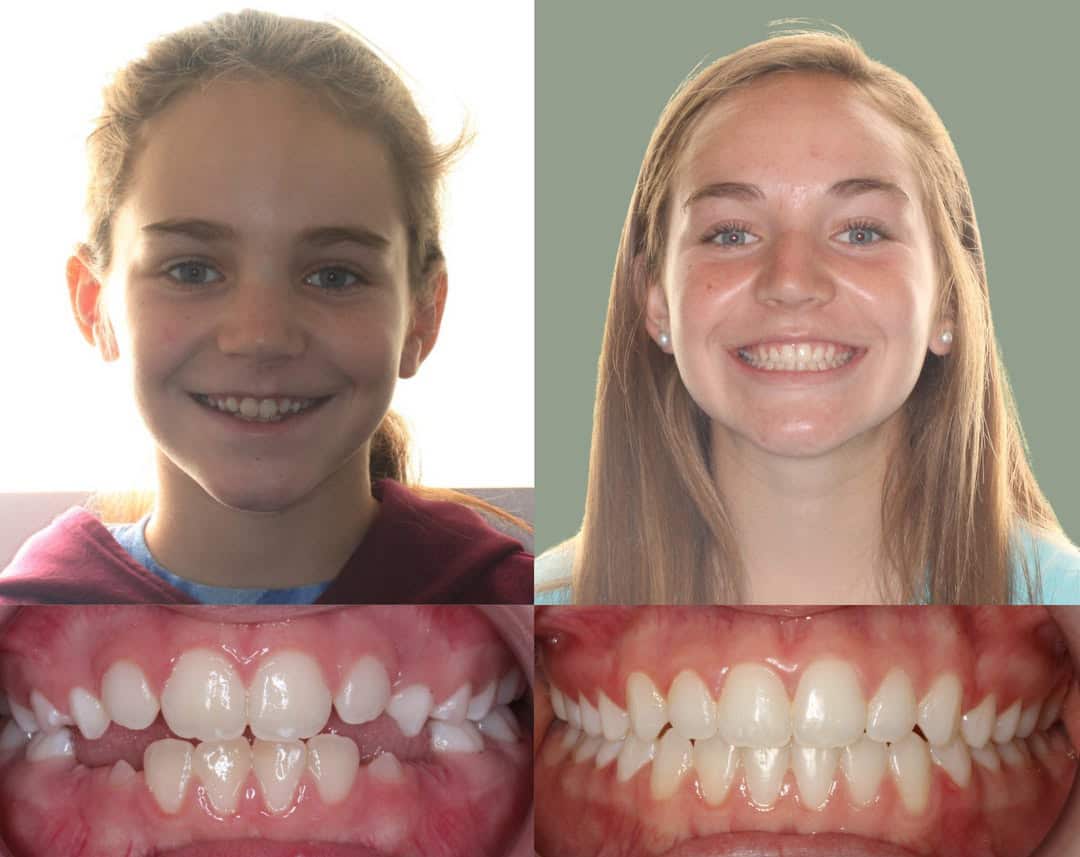
Take a look at our full overview of braces options if you want to understand what you’d be choosing between, or browse the before and after gallery to see what results actually look like.
Invisalign
A lot of parents assume clear aligners can’t handle an open bite. That’s understandable given how Invisalign is often marketed, but it’s not accurate for many cases.
When worn consistently, clear aligners create a natural bite block effect. The material across the back teeth helps intrude the molars when you close down, allowing the jaw to rotate into better alignment. For dental open bites and many moderate cases, this is genuinely effective.
For teens specifically, Invisalign Teen includes compliance indicators so parents can track wear time without guessing. For adults who want the most discreet path forward, our clear aligners for adults page covers what treatment actually looks like in a professional setting.
Learn more about Invisalign at Giardina Orthodontics.
That said, not every open bite is a good candidate for aligners alone. Severe skeletal cases may need a combined approach. Dr. Giardina will tell you directly what makes sense for your bite.
Early Intervention for Kids
The American Association of Orthodontists recommends an orthodontic evaluation by age seven. For open bites specifically, that recommendation is more important than it might seem.
Habit-related open bites are most effectively addressed while the jaw is still developing. Correcting a tongue thrusting pattern at age eight gives the bone time to remodel naturally as adult teeth come in. Wait until growth is complete and that window is gone.
Our Kids Club monitoring program is designed for exactly this. For children who aren’t ready for treatment yet, we track development at no cost, typically every six to twelve months. There’s no pressure and no commitment. It just means you’re not missing the right moment.
When early treatment does make sense, it usually falls under what’s called Phase 1 orthodontics, a shorter active phase focused on guiding jaw and tooth development before the permanent teeth fully come in.
If your child’s dentist has noted an open bite, or you’ve noticed that the front teeth don’t touch when your child closes their mouth, the simplest next step is a free evaluation. Our early treatment page explains what we look for and when we recommend acting.
When Surgery Comes Up
For severe skeletal open bites where the jaw structure itself is the root problem and orthodontic movement alone can’t produce a stable result, surgical orthodontics may be the right path. This involves repositioning the jaw surgically and securing it. It’s a significant process, and for the right cases, it delivers results that are stable for the long term.
What we won’t do is recommend surgery when a less invasive option will get the job done well. That’s not how Dr. Giardina approaches treatment. If surgery is genuinely what’s needed, she’ll explain why clearly and walk you through what to expect. If it isn’t, she’ll tell you that too.
The Tongue Thrusting Factor – Why Results Don’t Always Hold Without Addressing It
This deserves its own section because it’s the most overlooked part of open bite treatment, and because ignoring it is the most common reason open bites reopen after treatment ends.
Tongue thrusting is a swallowing pattern where the tongue pushes forward against the front teeth rather than pressing against the roof of the mouth. You might swallow between 500 and 1,000 times a day. Every time the tongue moves that direction, it applies gentle but persistent pressure against the teeth. That pressure, sustained over years, is enough to create or maintain a gap.
If the habit isn’t addressed during treatment, the teeth will gradually move back. The force that created the problem is still there.
Dr. Giardina evaluates tongue posture and swallowing patterns as part of every open bite assessment. Depending on what she finds, the plan might include awareness and habit retraining, a referral for myofunctional therapy (think of it as physical therapy for the muscles of the mouth and tongue), or for younger patients, a habit appliance that gently discourages the tongue from thrusting forward during treatment.
Getting the bite closed is one part of the work. Keeping it closed is the other. Both matter.
What Harrisonburg Families Say About Open Bite Treatment at Giardina Orthodontics
Suzi Martinez Carter
My 10-year-old son and I have had a great experience so far with Dr. G and her staff. He got his braces a few months ago and has needed a few comfort care visits, which have gotten scheduled quickly and without any hassle. The office is clean and bright, and their office dog Jerry is the sweetest.
Mackenzie Wood
If I could leave more than 5 stars, I would. Dr. G has been incredibly kind, patient, and reassuring from day one. I started in braces and later switched to Invisalign, and she made the transition seamless and stress-free. She genuinely cares about her patients and their results — you can tell she pays attention to the small details and takes pride in her work. Not to mention Jerry, who always adds an extra warm and fuzzy touch. If you’re looking for an orthodontist who is not only highly skilled but also compassionate, Dr. G is the one.
Brittany Williams
From the moment you walk through the doors, you can feel the difference. The staff greets you like family, and every visit feels less like an appointment and more like catching up with people who genuinely care. Dr. G goes above and beyond — not just with expertise, but with heart. She takes the time to explain every step, answer every question, and make sure you’re completely comfortable and confident in your care.
Why Shenandoah Valley Families Choose Giardina Orthodontics for Open Bite Treatment
Open bites are one of the more technically demanding bite corrections in orthodontics. The gap between a result that holds and one that gradually reopens often comes down to the thoroughness of the evaluation and the experience of the orthodontist managing the case.
Board certification and specialized research. Dr. Giardina is a Board-Certified Diplomate of the American Board of Orthodontics, which represents the highest level of credentialed expertise in the specialty. Her graduate research at Virginia Commonwealth University focused specifically on screening for pediatric obstructive sleep apnea in orthodontic patients.
That’s not a general credential. It’s directly relevant to the way open bites develop and what they mean for a child’s overall health.
A practice that takes kids seriously. If you’ve ever tried to get a child to do something consistently for eighteen months, you know how much the environment matters. Appointments at Giardina Orthodontics don’t feel like a chore. Jerry, our therapy dog, has a way of making kids forget they’re at an orthodontic office entirely.
The photo booth, the coffee bar for parents, the staff who actually remembers your kid’s activities from the last visit. All of it adds up to appointments that don’t require a fight to get through the door.
Comfort care visits, scheduled fast. Life with braces doesn’t always go smoothly. When something needs attention between regular appointments, we get patients in quickly rather than leaving them waiting uncomfortably for days. That’s something families notice. You can read more about how comfort care visits work at our office.
A real 5.0 rating with over 1,310 reviews. Not a carefully curated sample. The consistent feedback from across Harrisonburg, Bridgewater, Broadway, Staunton, and the surrounding valley is the same: the staff is warm, the care is thorough, and people feel genuinely looked after.
Flexible scheduling and payment options. We work with most major insurance plans, offer interest-free financing, and can help you understand exactly what you’d be looking at before any commitment is made. You can also explore your options through a virtual consultation before your first in-office visit if that’s easier.
What Does Open Bite Treatment Cost in Harrisonburg?
Open bite treatment at Giardina Orthodontics typically ranges from $3,000 to $7,000 depending on the complexity of the case and the approach used. Straightforward dental open bites may land on the lower end. More involved cases requiring extended treatment time or a combined approach will be toward the upper end.
Your free consultation includes a complete cost breakdown before any treatment begins. Insurance benefits applied, payment plan options laid out, total out-of-pocket cost with no surprises.
We accept most major insurance plans, offer interest-free in-house financing, and work with FSA and HSA benefits. See the full details on our financing page.
What to Expect at Your Free Consultation
If you’ve been wondering whether the open bite you’ve noticed deserves attention, here’s exactly what happens when you come in.
You’ll meet Dr. Giardina and the team. If it’s a first visit and your child is nervous, Jerry will likely be the first one to say hello.
We’ll take digital images and X-rays using our advanced imaging technology to give Dr. Giardina a complete view of your teeth, jaw structure, and bite. This is what makes it possible to determine whether an open bite is dental, skeletal, or a combination, and to plan something that actually fits your situation.
Dr. Giardina will walk you through what she’s seeing in plain language. Not clinical shorthand. Not a list of options handed off by a coordinator. You’ll talk directly with the person who would be managing your care.
You’ll leave with a clear picture of what’s going on, what treatment would look like, how long it would take, and what it would cost, with insurance benefits applied and payment options explained.
There’s no pressure and no obligation.

Frequently Asked Questions About Open Bite Treatment
Can an open bite be fixed without surgery?
In many cases, yes. Dental open bites caused by habits or tooth position often respond well to braces or Invisalign. Surgical orthodontics is typically reserved for severe skeletal cases where the jaw structure itself is the underlying problem and orthodontic movement alone can’t produce a stable result. Dr. Giardina always evaluates non-surgical paths first and will be direct with you about which category your bite falls into.
Can Invisalign fix an open bite?
For mild to moderate dental open bites, it often can. When worn consistently, clear aligners create a bite block effect through the aligner material on the back teeth, which helps the jaw rotate into better alignment. More complex skeletal cases may need braces or a combined approach. Your consultation will give you a specific answer based on your actual bite, not a general one.
How long does open bite treatment take?
Most open bite cases take between twelve and twenty-four months. Straightforward dental cases may land on the shorter end. Cases involving a more significant skeletal component typically take longer. You’ll get a personalized estimate at your consultation based on what Dr. Giardina actually sees.
My child still sucks their thumb. Do we need to stop that before starting treatment?
Ideally, yes. The habit is often part of what created or maintained the open bite, and continuing it during treatment works against the correction. Dr. Giardina can talk through strategies for habit elimination as part of the overall treatment plan. This is a very common situation and not something to feel embarrassed about.
Will the open bite come back after treatment?
It can, and the biggest risk factor is unaddressed tongue thrusting. If the swallowing pattern that contributed to the problem isn’t corrected during treatment, the bite can gradually reopen. Dr. Giardina evaluates tongue posture as part of every open bite case. Consistent retainer wear after treatment is also essential. Both pieces matter.
When should my child be evaluated for an open bite?
The AAO recommends a first orthodontic evaluation by age seven. For open bites, earlier is better, because the window for guiding jaw development while a child is still growing is one that closes. That doesn’t mean treatment starts right away. It means we know exactly what we’re looking at and when to act. Our Kids Club monitors children at no cost until the timing is right.
I’m an adult. Is it too late to fix mine?
Not at all. A meaningful portion of the patients we treat for open bites are adults who’ve been managing the issue for years. Modern treatment options, including Invisalign, make adult treatment very manageable. Earlier is less complex, but there’s no age past which correction isn’t possible. You can read more on our adult orthodontics page.
Could my child’s open bite be connected to breathing or sleep issues?
It’s worth asking. Open bites are associated with narrow jaw development, mouth breathing, and disrupted sleep in children. Dr. Giardina’s research background in pediatric obstructive sleep apnea means she’s specifically trained to look for these connections during an evaluation. If your child breathes through their mouth, snores, or seems unrested, mention it when you come in. It’s clinically relevant. You can learn more on our airway orthodontics page.
What’s the difference between a dental open bite and a skeletal open bite?
A dental open bite is a tooth position problem. The jaw structure is normal but the teeth have shifted, often because of a prolonged habit like thumb sucking or tongue thrusting. These cases generally respond well to braces or Invisalign.
A skeletal open bite involves the jaw itself, typically vertical growth patterns that keep the teeth from meeting even in their ideal positions. These cases are more complex and may involve surgical correction alongside orthodontic treatment. Dr. Giardina will determine which type you’re dealing with during your evaluation.
Ready to Get a Real Answer?
If you’ve been putting this off because you weren’t sure how serious it was, or because the thought of surgery was too overwhelming to deal with, this is the right time to come in and find out what you’re actually dealing with.
Giardina Orthodontics
2505-A Evelyn Byrd Ave, Harrisonburg, VA 22801
540-433-8814
Monday through Thursday: 8am to 5pm
Serving Harrisonburg, Bridgewater, Broadway, Dayton, Massanutten, Staunton, Grottoes, and the surrounding Shenandoah Valley.