
You already know you would like your teeth to be straighter. That part is easy.
The harder questions are the ones people actually sit with: Is it too late for me? Will this cost more than it should?
Am I going to get talked into something I do not need? Those are fair things to wonder, and they are exactly what we walk through with you at a free consultation, with no pressure and no obligation to start.
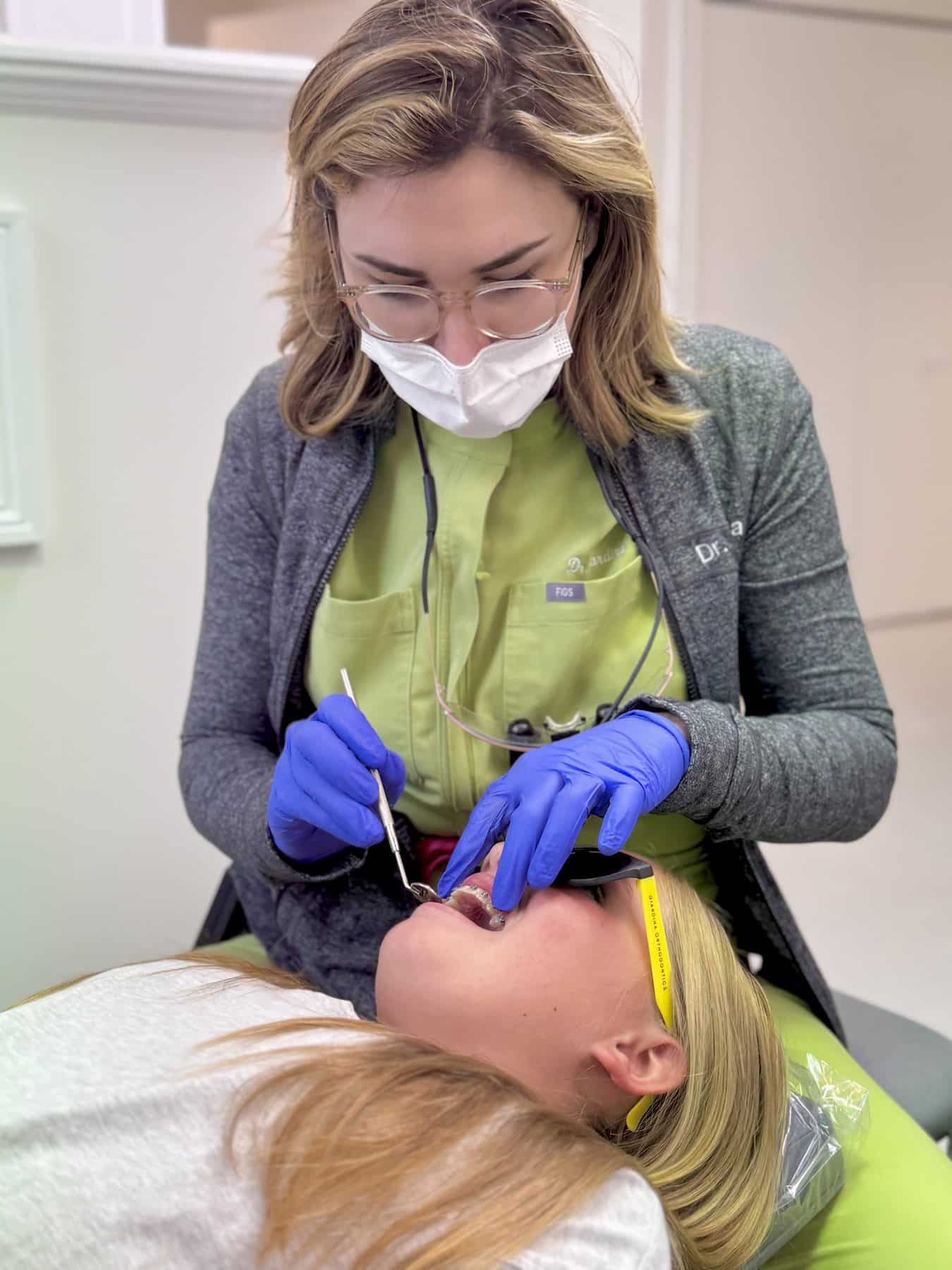
At Giardina Orthodontics, we straighten crooked teeth for kids, teens, and adults across Harrisonburg, Bridgewater, Dayton, Broadway, Massanutten, and the rest of the Shenandoah Valley, using Invisalign and braces with two goals in mind at once: a smile you are genuinely happy to show, and a bite that works the way it is supposed to. What sets Dr. Giardina apart is where she begins.
Before she focuses on the couple of teeth that bother you in photos, she looks at why they came in crooked in the first place, including how the jaw developed and how well you breathe. With her board certification and a research background in screening for pediatric airway issues, she has learned that crooked teeth are often the visible piece of a larger picture.
- Board-certifiedABO Diplomate
- 1,351+ 5-star reviewson Google
- Free consultationsno pressure
- Same-day startsavailable
- Interest-free financingflexible plans
- No referral neededjust call us
You have been thinking about this for a while. Most of our patients had too.
Almost no one is born with perfectly aligned teeth, and plenty of people live with a little crowding for years before they do anything about it. See if any of these sound familiar:
- You had braces as a kid, stopped wearing the retainer, and watched everything drift back.
- You never had treatment, and your teeth slowly shifted as the years added up.
- You have meant to deal with it forever, and this is finally the year you stop putting it off.
Whichever one fits, you have not missed your chance. A lot of the adults we treat walked in convinced they were too old for this, so if that is the story you have been telling yourself, you are in good company here.
The thing those patients tell us afterward is that they only wish they had come in sooner.
Why teeth come in crooked
Teeth do not crowd by accident. Some of it is genetics, but a lot of it comes down to how much room the jaw gave the teeth to grow into.
And that piece, the size and shape of the jaw, is where the story gets bigger than most people expect. The usual culprits:
Not enough room. A narrow upper jaw or a small arch leaves teeth nowhere to settle, so they overlap and rotate to fit. Here is what many people never hear: that same narrow jaw also leaves less space behind it for the airway.
The roof of the mouth is the floor of the nose, so a high, narrow palate often comes with tighter nasal passages. The crowding you can see and the breathing you cannot often trace back to the same underdeveloped jaw.
A bite that does not line up. When the upper and lower jaws meet unevenly, as with an overbite, underbite, or crossbite, teeth tend to tip and slide to compensate, and crowding follows.
Early childhood habits. Long-term thumb sucking, mouth breathing, and a low resting tongue position can all shape how the jaw grows. When a child breathes through the mouth, the tongue drops away from the roof of the mouth, the palate misses the gentle outward pressure it needs to widen, and the arch tends to narrow.
Less room means more crowding, and the pattern reinforces itself. This is why we offer habit appliances when those habits are part of the picture.
Time. Teeth keep moving for life. Even a beautiful result from childhood braces can crowd again, especially once the retainer stops getting worn.
The reason behind the crowding matters, because it changes the fix. Two people with smiles that look almost identical can need very different plans.
That is why Dr. Giardina works out what is actually causing your crooked teeth, and whether your jaw and airway are part of it, before she recommends anything at all.
Crooked teeth are about more than how they look
Most people do not hear this part until they are in the chair. Straightening crooked teeth usually does more than clean up your photos.
Crowded, overlapping teeth are harder to keep clean, and over the years that raises the odds of cavities and gum trouble in the exact spots a toothbrush and floss cannot reach. A bite that meets unevenly can wear some teeth down faster than others and leave the jaw working harder than it should, which is one of the reasons crooked teeth and jaw soreness so often show up together.
There is even a documented connection between crooked teeth and digestion, since chewing well is the first step of breaking food down.
And then there is the part you cannot see in the mirror. When crowding traces back to a narrow, underdeveloped jaw, that same structure can leave less room for breathing, which sometimes shows up as snoring, mouth breathing, or restless sleep.
We want to be clear about where the lines are here. Dr. Giardina does not diagnose or treat sleep apnea; that is a medical question that belongs with your physician.
What her training prepares her to do is recognize when jaw structure and airway space appear to be part of the picture, address that structure within orthodontics, and coordinate with your doctor or an ENT when a medical question comes up. Her residency research at VCU focused on screening tools for evaluating airway issues in young orthodontic patients, so this is something she watches for closely.
None of that means every crooked tooth is hiding a bigger problem. Plenty of people have a little crowding and nothing else going on, and that is completely fine. It just means it is worth having a trained set of eyes look at the whole picture, which is the entire point of a free consultation.
“When a patient comes in about crooked teeth, I am not only looking at where the teeth ended up. I am looking at the jaw underneath them and whether there was enough room for things to develop the way they should have. The position of the teeth is often a clue to a bigger structural story, and that is why I look at jaw growth and breathing before I ever recommend a treatment.”Dr. Julia Giardina
Wondering if it is even worth it?
One free visit gives you a straight answer and a real plan, whether you start now or not.
See your treatment options or call 540-433-8814Signs your crooked teeth are worth a closer look
Lots of people have crooked teeth and never notice anything beyond how they look, and that is okay. But a handful of signs are worth paying attention to, because they can mean your bite, your alignment, or your breathing deserves a real evaluation:
- Floss snags or will not slide between tight, overlapping teeth
- Cavities that keep turning up in the same crowded spots
- Teeth that are wearing down unevenly
- Jaw soreness, clicking, or a tired, tense feeling around the joint
- Grinding or clenching, especially at night
- Snoring, ongoing mouth breathing, or waking up tired no matter how long you slept
- A bite that just never seems to come together quite right
If a couple of those ring true, it is worth booking a look. Notice how several of them have nothing to do with appearance.
That is on purpose. With children especially, the signs that matter most tend to show up at night and at the breakfast table, not in the mirror, which is why we pay attention to symptoms rather than waiting on a particular birthday.
See what’s possible for your smile
Three quick questions. No email, no sign-up, just a starting point so you know what to ask about.
Who are we looking at today?
What bothers you most right now?
What matters most day to day?
Crooked teeth in children: when an early look helps

In a child, the signs to watch for usually are not the crooked teeth themselves. They are snoring, breathing through the mouth, grinding at night, restless sleep, or trouble focusing during the day.
Crowding that appears as the baby teeth give way to permanent ones is worth a look too. Those are the clues that the jaw may not be developing the width it needs, and the crowding is one symptom of that.
This is the part of orthodontics Dr. Giardina cares about most, because childhood is when the jaw is still growing and most responsive to guidance. The American Association of Orthodontists recommends a first orthodontic check by age seven, and our complimentary Kids Club monitoring program lets us keep an eye on how things are developing without rushing into treatment.
While the bones are still growing, there is a window to gently encourage the upper jaw to widen and make room for teeth to come in straighter. That window does not stay open forever, which is why we would rather take an early look and decide together whether anything needs doing now than tell a family to simply wait and see.
If you have noticed any of those nighttime signs in your child, our pages on early treatment and Phase 1 braces in Harrisonburg walk through what an early evaluation actually looks like.
How crooked teeth actually get fixed
It starts with figuring out why they got crooked and how much movement your case really needs. Lighter crowding can often be handled with clear aligners.
More involved crowding or a bite issue usually calls for braces, which give Dr. Giardina more precise control over each tooth. And when the real problem is a jaw that never developed enough width, the most lasting answer is often to make room rather than simply rearrange what is there.
That last point is where Dr. Giardina’s approach parts ways with the old playbook. The traditional answer to a crowded mouth was sometimes to pull teeth to create space.
Her first question is different: is there a way to develop the arch and give the teeth the room they were always meant to have? For growing kids, that can mean guiding jaw growth early.
For patients whose jaws have finished growing, a palatal expander can sometimes widen a narrow upper jaw without surgery, making room for teeth and supporting the airway at the same time. Removing teeth is occasionally still the right and safest call, and she will tell you plainly if it is.
The point is that it is a decision, not a reflex.
Whatever path you choose, treatment is far more comfortable than it used to be. We use Damon self-ligating braces, a modern system that moves teeth with gentle, steady pressure and fewer tight adjustments than the braces you might remember.
And if you are bracing for a worst-case scenario, the large majority of crooked-teeth cases are handled with braces or aligners alone, with no surgery involved.

Your options at Giardina Orthodontics
For most crooked-teeth cases it comes down to clear aligners or braces, and the right one depends on your situation more than on the label.
Invisalign and clear aligners
Invisalign and clear aligners are a favorite for adults and older teens who want something low profile. The aligners are clear, removable, and easy to clean around, with no brackets or wires to plan meals around.
They handle a wide range of crowding and spacing. When aligners are the plan, we map the movement of your teeth with a quick digital scan, so there are no putty trays to gag on.
The catch with aligners is that they only work if you wear them, around 20 to 22 hours a day, out only for meals and brushing. If keeping up with that sounds like a stretch, braces may be the better fit, and Dr. Giardina will say so rather than sell you on the option that looks nicer.
We offer aligners for teens and dedicated clear aligners for adults alike.
Braces
Traditional metal braces are still one of the most dependable ways to straighten crooked teeth, and they shine on heavier crowding and bite problems. Today’s brackets are smaller and more comfortable than what you may picture, and we even offer them in a champagne gold finish.
If you like the idea of braces but want them to blend in, clear ceramic braces are far less noticeable while doing the same work. Not sure which direction makes sense?
Our breakdown of Invisalign versus braces lays out the trade-offs.
Straightening crooked teeth: your main paths
Now for the question everyone is really asking: cost. Fees vary quite a bit from one person to the next, because what you need depends on your case, not on a sticker price, so we do not post ranges that would not apply to you anyway.
What you will get is a complete, personalized breakdown at your free consultation with no surprises, plus flexible, interest-free payment plans, and our team will check your insurance benefits for you. If you want to understand what shapes the number before you come in, our guide to how much braces cost in Harrisonburg walks through it.
Not sure which option fits?
Dr. Giardina looks at your teeth, your bite, and your airway, then gives you a straight recommendation with real numbers.
Find out if you qualify or call 540-433-8814How long does crooked teeth treatment take?
Most crooked-teeth treatment runs somewhere between a few months and about two years. How long yours takes depends mostly on how crowded things are to begin with, since that sets how far your teeth need to move.
- Mild crowding, just a few slightly overlapping teeth, often wraps up in roughly six months to a year, and these are the cases aligners tend to finish fastest.
- Moderate crowding usually lands somewhere around twelve to eighteen months, whether you choose braces or aligners.
- Heavier crowding, or a case that also involves developing the jaw, can run longer, since there is more happening than lining up the front teeth.
Whichever camp you fall into, braces are adjusted about every six to eight weeks, and aligner check-ins land every several weeks. At your consultation, Dr. Giardina gives you a realistic timeline built around your actual teeth, not a generic estimate.
What results can you expect?
Most people picture one outcome: straighter teeth. You will get that.
But the changes worth the effort tend to be the quieter ones that show up afterward. A smile you stop thinking twice about.
Teeth that are finally easy to keep clean, because your brush and floss can reach surfaces that used to trap plaque. A bite that meets evenly, so chewing improves and the workload spreads across your teeth instead of grinding down a few.
Less uneven wear and jaw strain. And where treatment involved developing or widening a narrow jaw, structure that may better support breathing, which Dr. Giardina keeps within orthodontic scope rather than treating any medical condition.
You can see what real local results look like on our before and after gallery.

What your free consultation actually looks like
Deciding to do this takes a little nerve. The visit itself should not.
Here is exactly what happens, with nothing hidden. You are greeted by name at the front desk.
We take the X-rays and photos needed to evaluate your teeth, your bite, and how the jaw is built. Then Dr. Giardina herself, not an assistant and not a coordinator, looks at how everything fits together, including how you breathe, and walks you through what she finds.
You leave with a clear treatment plan, a realistic timeline, and a full financial breakdown that covers your insurance and payment options. If you are ready, qualifying patients can start the same day.
The whole thing takes about an hour, there is zero obligation, and you do not even need a referral to come see us. Here is a closer look at what to expect on your first visit.
What happens at your free visit
About an hour, start to finish, and no obligation at the end.
- Warm welcomeYou’re greeted by name, not a number.
- Digital scan & X-raysA quick scan and images of your teeth, bite, and jaw. No putty trays.
- Dr. Giardina’s examShe looks at how everything fits, including how you breathe, and explains what she sees.
- Your plan & real numbersA clear plan and a full cost breakdown, insurance included.
- Start same day, if you wantQualifying patients can begin right away. Zero pressure either way.
If you or your child are nervous about coming in
Feeling unsure before a first visit is normal, and it does not change how the appointment goes. A few things tend to take the edge off.
An evaluation is not a commitment to treatment, and plenty of people come in, get a clear answer, and leave with nothing to do yet. With kids especially, the result is often a simple “this looks good for now, let us check again in a while” rather than braces next week.
Nobody here is going to make you feel bad for waiting, whether it has been five years or thirty, because the only question we care about is what makes sense now.
The visit itself is gentle. There is no drilling and nothing sharp, just a few quick X-rays and photos and a conversation.
You see the numbers before you decide anything, so there is no pressure to commit on the spot, and you can take the plan home to sit with it. For a worried child, it helps to hear that the first appointment is only looking and talking, with no work done that day.
Dr. Giardina sees nervous young patients all the time, and our therapy dog Jerry, the unofficial CEO of comfort around here, has a way of turning a tense waiting room into the easiest part of the day. If something specific is on your mind, tell us when you book and we will plan around it.
We also have a Spanish-speaking team member to make the conversation easier for families who prefer it.
Why a trained orthodontist beats a mail-order aligner kit
Order-from-home aligner kits look tempting because they are cheap and you never have to leave the couch. The catch is what they skip.
Those kits move teeth based on a mold you take yourself, with no doctor checking your bite, your gum health, or your jaw along the way. They can nudge the teeth that show when you smile, but they are not built to correct how your top and bottom teeth come together, and a tooth pushed the wrong way without supervision can affect your bite, your gums, or how well the result holds up over time.
There is one more thing a boxed kit simply cannot do, and it is the thing Dr. Giardina pays the most attention to: it cannot look at your airway. No X-rays, no bite assessment, no check for whether a narrow jaw is quietly making breathing harder.
With crooked teeth, the jaw is usually part of the story, and that is the piece a kit in the mail will never see. If you have already started a kit or had treatment elsewhere and have doubts, we are glad to give you a free second opinion.
Why Shenandoah Valley families choose Giardina Orthodontics
A few things set us apart for crooked-teeth treatment specifically.
We treat the whole picture, not just the front teeth. Straightening is the goal, but Dr. Giardina also evaluates how your teeth meet, how your jaw is built, and how you breathe, because that is usually why the teeth got crooked in the first place.
That is the difference between covering a symptom and addressing the cause.
Our training goes beyond teeth. Dr. Giardina earned her orthodontics certificate and a Master of Science in Dentistry from Virginia Commonwealth University, is a Board-Certified Diplomate of the American Board of Orthodontics, and built a research background in screening for airway issues in young patients.
You can read more about what board certification actually means and why it matters.
You see Dr. Giardina herself, every visit, with no rotating associates and no being handed off. Our Harrisonburg families have left more than 1,351 five-star reviews, which we would rather earn than ask you to take our word for.
And the office itself is built to make treatment something people do not dread, with a coffee bar for parents, a photo booth, a kids’ corner, and of course Jerry.
What our patients tell us
A lot of people walk in assuming their case is either too minor to bother with or too far gone to fix. Usually it is neither. Adults especially tell us they were nervous to start, then mention afterward how clearly Dr. Giardina explained everything and how she never rushed them.

“As a 50+ year old man who does a lot of public speaking, I was hesitant about getting braces or trays. Over the years I had grown a crossbite that ended up chipping an incisor, and it wasn’t going to get better over time. So I decided to go through with trays. Dr. Giardina and the staff have been amazing since day 1! They are very attentive to how I feel my teeth are responding, super responsive to my questions, and amazingly friendly. I highly recommend them to anyone considering braces or trays.”Brad B. ⭐⭐⭐⭐⭐
“I have been with this practice for almost 2 years and will never be able to put into words how phenomenal they are. As an adult being hesitant about getting braces, they have been supportive every step of the way! If you are looking for a fun and upbeat orthodontic office to go to, this is it!”Katie R. ⭐⭐⭐⭐⭐
“Our kiddos love going to see Dr. G! She and her team create a warm, caring and friendly environment. The staff and Dr. G always remember our kids’ activities and interests and ask them about it during their appointments. The kids’ corner and photo booth are always the highlight of our visits, and the coffee bar for parents is lovely as well.”Julianne M. ⭐⭐⭐⭐⭐
See what Harrisonburg families are saying
Crooked teeth treatment across the Shenandoah Valley
Wherever you are in the Valley, our Harrisonburg office is an easy drive. We regularly treat families from Harrisonburg, Bridgewater, Dayton, Broadway, Massanutten, Elkton, Grottoes, McGaheysville, Penn Laird, Timberville, Mount Crawford, and Staunton, along with the rest of Rockingham County and into Augusta and Page counties.
We are right off Evelyn Byrd Avenue with easy access from I-81, so a straighter smile does not have to mean a long trip.
Giardina Orthodontics
2505-A Evelyn Byrd Ave.
Harrisonburg, VA 22801
Hours: Monday through Thursday, 8am to 5pm
Common questions about crooked teeth
Can crooked teeth be fixed as an adult?
Yes, and it works well later in life. Many of our patients are adults, and whether you go with clear aligners or braces, crooked teeth can be straightened at almost any age.
The main difference for adults is that Dr. Giardina pays extra attention to gum health, your bite, and your airway before starting, since adult jaws have finished growing.
Are crooked teeth only a cosmetic problem?
Not always, though they are often more than that. An uneven bite can wear certain teeth faster than others and leave the jaw working harder than it should.
And when crowding traces back to a narrow jaw, that same structure can affect how well you breathe. So straightening can change how your smile feels and works, not only how it looks.
Can crooked teeth affect breathing or sleep?
They can be connected. A narrow, underdeveloped jaw can crowd the teeth and, at the same time, leave less room for the airway, which is part of why some people snore or breathe through their mouth.
To be clear, Dr. Giardina does not diagnose or treat sleep apnea, which is a medical matter for a physician. What she does is recognize the jaw and structural factors that can contribute to breathing issues and address that structure within orthodontics, working alongside your doctor when needed.
You can read more on our airway orthodontics page.
Can crooked teeth cause gum problems?
They can play a part. When teeth overlap, a toothbrush and floss cannot always reach the tight spots between them, so plaque builds up where it is hardest to clean. Over time that raises the risk of gum inflammation, and straightening the teeth makes them easier to keep clean.
What happens if I leave crooked teeth untreated?
For a lot of people, nothing dramatic, and that is okay. The catch is that crooked teeth do not straighten on their own, so the things that make them worth treating, like harder cleaning and an uneven bite, simply continue.
Cases also tend to be simpler to treat sooner than later, so even if you are not ready to start, a quick look tells you whether waiting costs you anything.
Are crooked teeth genetic?
Often, yes. A lot of what determines whether teeth come in straight is inherited, including jaw size, tooth size, and how the bite develops.
That said, genetics is not the whole story. Childhood habits like mouth breathing and thumb sucking, plus natural shifting over time, play a part too, which is why two people in the same family can have very different smiles.
Do crooked teeth get worse with age?
They can. Teeth keep drifting throughout life, so crowding tends to become more noticeable as the years go on, often showing up first in the lower front teeth. It is one of the most common reasons adults come in for treatment they assumed they were long done with.
Should I get braces or Invisalign for crooked teeth?
Both do the job. Clear aligners are removable and discreet, which a lot of adults prefer, while braces give Dr. Giardina more control on heavier crowding or bite issues.
The best pick depends on your teeth, your bite, and your daily routine, and she will give you a straight answer at your consultation.
Can Invisalign fix severely crooked teeth?
In many cases, yes. Clear aligners have come a long way and can handle cases from mild to fairly complex.
But not every severe case is a good aligner candidate, especially when the bite needs major correction or teeth have to travel a long way. An exam settles it, and Dr. Giardina will tell you whether aligners can get you all the way there or whether braces are the more reliable route for your case.
Will I need to have teeth pulled to fix crowding?
Sometimes, but often not. Teeth need room to straighten into, and in a lot of cases Dr. Giardina can create that room by developing or expanding the arch rather than removing anything, which also protects the space your tongue and airway need.
With more severe crowding, taking out one or more teeth is occasionally part of the safest, most stable plan. Your free consultation will make all of that clear before any treatment begins.
Does treatment hurt the way it did when I was a kid?
It is gentler than it used to be. Modern brackets and wires apply lighter, steadier pressure, so most people feel some soreness for a few days after an adjustment rather than sharp pain, and it settles quickly.
My child is nervous about the orthodontist. What is the first visit like?
The first visit is only looking and talking, with no treatment done that day, which takes most of the worry out of it. We take a few quick, painless X-rays and photos, Dr. Giardina looks things over, and she explains what she sees in words a child can follow.
It also helps that Jerry, our therapy dog, is usually the first one to say hello.
I had braces as a kid and my teeth shifted. Is that normal?
Completely normal. Teeth keep moving for life, and crowding often returns when retainers are not worn consistently.
The good news is that a second round is usually shorter and simpler than the first, and a lot of the adults we treat are in exactly this situation. It is also a good moment to find out whether a narrow jaw was part of why things drifted.
Will I really have to wear a retainer forever?
At night, yes. Once your braces or aligners come off, you wear a retainer at night to hold everything in place, because teeth have memory and keep trying to creep back.
Dr. Giardina talks through your retainer plan before treatment even begins, so it is not a surprise at the finish line.
Find out exactly what is going on, in one free visit
Sit down with Dr. Giardina, get an honest answer, and leave with a clear plan and real numbers. No pressure, no obligation, and no referral needed.
Book your free consultation or call 540-433-8814